
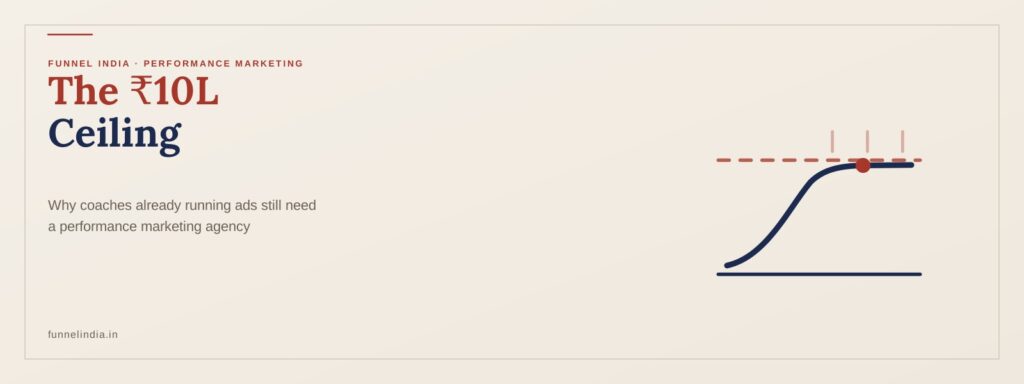
There is a particular frustration that shows up around the ₹10 lakh a month mark. The business works. Clients sign. Revenue is predictable enough that you have stopped checking the bank balance every morning. And yet every attempt to push past this level either costs more than it returns, or quietly breaks something that was working fine.
The instinct is to blame the ads. Sometimes that is right. At this stage, more often it is not. Most coaches who hit this ceiling do not have a marketing problem — they have a systems problem that looks like one, which is exactly the gap a performance marketing agency is meant to close.
The ceiling that shows up at this stage
Getting to steady monthly revenue as a coach usually happens one of two ways. Either you built an audience and monetised it, or you found one ad angle that worked and kept feeding it. Both are legitimate, and both have a natural ceiling you tend to meet without warning.
The ceiling is not about budget. It is about how many things one person can hold in their head at once. Double the spend and the moving parts do not double — they square. Audiences overlap. Creative fatigues faster. Follow-up slips. The calendar fills with people who were never going to buy. Nothing has broken; the system has outgrown the way it is being run, and every symptom surfaces in the ad account because that is where the money is visible.
Three things that quietly break
When a performance marketing agency audits coaching businesses at this level, the same three issues come up often enough to be predictable.
Your ads are propping up a funnel that should carry itself
A funnel that converts at low volume can look fine for a long time, because warm traffic forgives a lot. Your existing audience already knows you. They will book a call off a thin landing page because they have been reading your posts for a year.
Cold traffic is not so generous. Scale means buying attention from people who have never heard your name, and they judge the offer entirely on what is in front of them. Every weak spot in the funnel architecture — a vague promise, a booking page asking too much, a gap between opt-in and first contact — starts costing real money. The ad account shows rising costs. The actual problem sits further down.
You are still being measured on cost per lead
Cost per lead is the most comfortable metric in performance marketing and one of the least useful. It is easy to improve, and easy to improve in ways that make the business worse. Broaden the audience, soften the hook, drop the qualifying question, and watch the number fall while your calendar fills with people who cannot afford the program.
The number that matters is cost per signed client. We have run campaigns where leads from one region cost more than double those from another and still produced clients at a lower total cost, because they were three times likelier to buy. A cost-per-lead view would have shifted budget to exactly the wrong market. If nobody is connecting closed revenue back to the campaign that produced it, you are optimising on a proxy and hoping it correlates.
Nobody owns the space between the channels
Most coaching businesses at this stage have each piece covered. Someone runs the ads, someone edits the videos, someone handles WhatsApp, the founder takes the calls. Every piece is handled, and the gaps between them belong to nobody.
That is where leads go cold. A form fill at 9pm that nobody answers until the next afternoon. A retargeting audience never excluded from the prospecting campaign, so you pay twice to reach one person. A landing page edit that broke tracking three weeks ago, unnoticed because the ads kept spending. None of these are anyone’s fault. They are structural, and trying harder does not fix them — which is the strongest argument for bringing in a performance marketing agency rather than hiring another specialist.
What a performance marketing agency actually changes
The honest answer is that a performance marketing agency does not usually make your ads dramatically better. If you have run them for a while, your ads are probably fine. What changes is ownership of the whole path from first impression to signed client, and the measurement underneath it.
How it usually runs in-house | What changes with an agency |
Ads optimised on cost per lead | Campaigns judged on cost per signed client, tracked back to source |
One campaign covering every market | Separate campaigns per market, each judged on its own results |
Creative refreshed when results dip | Creative tested on a schedule, before fatigue shows in the numbers |
Follow-up handled when someone is free | Automated first response, sales conversation picked up warm |
Tracking set up once and assumed to work | Tracking verified as part of reporting, because it breaks silently |
Budget raised to chase growth | Budget moved toward what converts, raised only once it holds |
None of this is exotic. It is the difference between a set of marketing activities and a system where each part knows what the others are doing. A performance marketing agency earns its retainer by owning that system, not by having a secret audience you do not know about.
When you genuinely do not need one
Some coaches at this level should not hire a performance marketing agency, and it is worth saying so plainly.
If revenue comes mostly from referrals and repeat clients and you are happy with that, paid acquisition adds cost and complexity before it adds much else. If your offer is still changing every quarter, hold off — a performance marketing agency will build a system around a promise that is about to move, and you will pay to rebuild it. If someone in-house genuinely owns the full path from ad to signed client and has time to do it, you may already have what an agency would provide.
And if delivery capacity is the real constraint, more leads make things worse. We have said this in discovery calls and watched people look relieved. Fixing what is actually limiting you beats paying someone to pour volume into it.
If you take one operational action from this post, make it that one. The pixel costs nothing to install and starts accumulating something you cannot retrieve later.
What the first ninety days look like
When the fit is right, early work is less glamorous than most people expect. The first few weeks are diagnostic: tracking verified end to end, the funnel walked as a cold prospect would walk it, past campaign data rebuilt around signed clients rather than leads. That last step alone often changes which campaigns look successful.
From there it is structural. Campaigns get separated so each market and offer can be judged on its own. Follow-up gets automated so no enquiry waits overnight. Creative testing moves onto a schedule instead of happening in response to a bad week.
Scaling comes last, deliberately. Raising budget on a system you have not yet proven is how good months turn expensive. A performance marketing agency that pushes spend in week two is managing your impatience, not your pipeline.
A reasonable expectation Most coaching accounts need two to three months before the numbers mean anything. The first month is diagnosis and rebuilding. The second shows whether the structure holds. By the third you should be able to point at a campaign and say what a signed client from it actually cost. Anyone promising a transformation inside thirty days is selling the first month twice. |
We also decline work where the coaching program has never sold, where the entire budget would go into the build with nothing left to run traffic, and where the monthly spend cannot realistically clear the learning phase. A funnel scales something that already works. It does not establish whether it does.
Should you book a call?
Being honest about fit saves everyone time, so here is the short version.
Worth a conversation if
- You run paid ads consistently and revenue has plateaued despite steady or rising spend
- You cannot currently say what a signed client costs you by campaign
- Your offer is stable and delivery can absorb more clients than you have
- Follow-up on new enquiries depends on someone being available rather than on a system
Do not fill the form yet if
- Your offer or pricing is still changing every few months
- Delivery is already at capacity — fix that constraint first
- You are looking for results inside thirty days
- Referrals cover your pipeline and you are happy with that
If the first list describes your situation more than the second, a discovery call is the right next step. Funnel India is a performance marketing agency built around coaching businesses: we will look at your account, your funnel and your close rate, and tell you plainly whether we can move the number — including when we cannot.
Frequently asked questions
We already have someone running our ads. Does an agency replace them?
Not necessarily. If your media buyer is good, the gap is rarely in the ad account — it is in everything around it. Plenty of arrangements work where the in-house person keeps running day-to-day campaigns while the performance marketing agency owns funnel architecture, tracking and measurement. Decide which problem you are solving before replacing anybody.
How is this different from hiring a funnel consultant?
A consultant tells you what to build and leaves you to build it. A performance marketing agency builds it and stays accountable for what it produces. Consulting works well when you have a capable team and need direction. It works badly when the reason things are not getting fixed is that nobody has bandwidth.
Will we lose control of our ad account?
You should not, and you should insist on it. Your business should own the ad account, the pixel, the audiences and the creative assets, with the agency working inside your account rather than their own. If a performance marketing agency wants to run campaigns from their account, understand that you are renting the audience data your spend is building, and you will not keep it when the relationship ends.
What if our offer is high-ticket and the sales cycle is long?
That makes measurement more important, not less. Long cycles mean the ad platform’s attribution window closes before the sale happens, so the platform undercounts what is working. The fix is tracking enquiries through to closed revenue in your own records, rather than trusting the dashboard.
Is SEO worth doing alongside paid ads at this stage?
Yes, but understand the timelines. Organic search and AI visibility compound over quarters, not weeks, and neither solves a revenue problem this month. Paid remains the right tool for immediate client acquisition. Run both, with paid carrying the near-term pipeline while organic builds underneath it.
How do we choose between agencies?
Ask each one how they would measure success, and listen for whether the answer involves your revenue or only their dashboard. Ask who owns the ad account. Ask what they would do in month one — anyone who says scaling has not understood the problem. A performance marketing agency worth hiring will tell you what they cannot fix as readily as what they can.